Begin with the product record
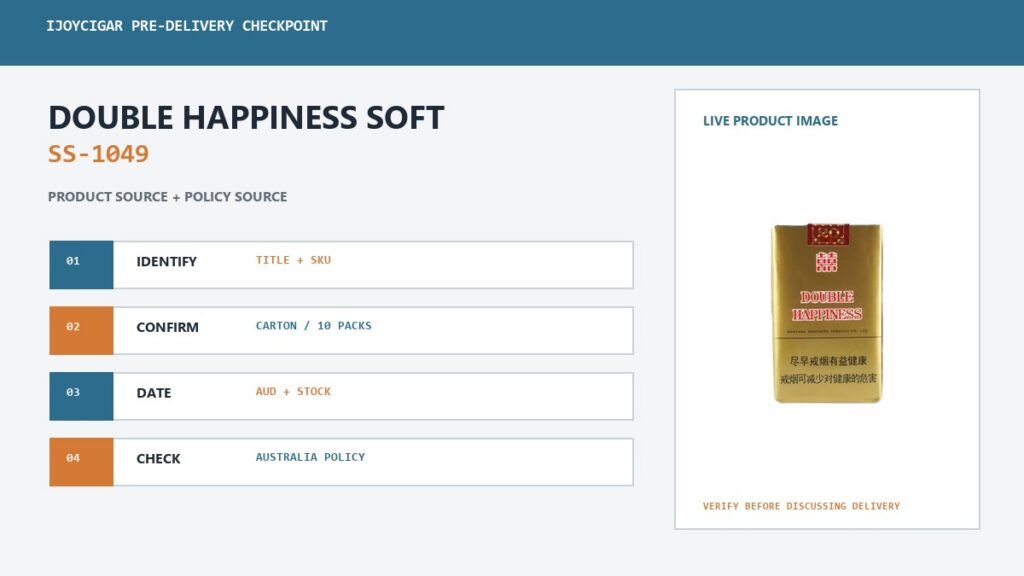
Before discussing delivery, identify exactly what the catalogue lists. The live Double Happiness Soft product record reviewed on 18 August 2026 showed Double Happiness Soft – 1 Carton (10 Packs), SKU SS-1049, an AUD amount of A$242.62 and an in stock state. It also carried the current product image. These are observations of one public page at one time; they are not a delivery promise, an order result or a statement about future stock.
The purpose of a pre-delivery check is to keep two sources from being blended. The product page owns identity and live catalogue fields. The shipping and returns pages own their published policy subjects. A useful note records both without asking the product title to answer a policy question or asking a policy page to identify a product variant.
Capture the identity fields first
Write the complete title before copying any amount. Double Happiness is the recorded brand family, Soft is the named variant, and the final phrase states the sale unit. SKU SS-1049 is the exact lookup key that ties the title to the final page.
| Identity field | SS-1049 observation | Check rule |
|---|---|---|
| Complete title | Double Happiness Soft – 1 Carton (10 Packs) | Keep the variant and unit wording intact |
| SKU | SS-1049 | Match letters, hyphen and digits exactly |
| Sale unit | One carton containing 10 packs | Keep it attached to any amount |
| Final route | Product detail page | Do not use a search result as the endpoint |
If one field conflicts, stop the delivery discussion and resolve the record first. A similar pack colour or a nearby Double Happiness title cannot inherit SS-1049 facts.
Separate live conditions from stable identity
The title, SKU and sale unit form the identity block. Price, stock and image are live conditions that may change independently. The reviewed page displayed A$242.62 in AUD and in stock on 18 August 2026. Add the date beside those values so a later reader knows what was actually observed.
| Dated condition | Observation | What it does not establish |
|---|---|---|
| Displayed amount | A$242.62 AUD | A permanent or customer-specific total |
| Availability | in stock | A reservation or future availability |
| Product image | Current attached file loaded | Origin, authenticity or future packaging |
| Review time | 18 August 2026 | A guarantee that conditions will persist |
When a later check produces a different amount or stock state, append a new row. Do not rewrite the earlier row and make the catalogue history appear unchanged.
Use broad catalogue routes only for discovery
The IJoyCigar Shop is useful when a reader needs to find the product route again. A shop card is not the final identity source: it can abbreviate a title, change ordering or present a resized image. Follow it to the detail page and repeat the four identity checks.
The Double Happiness category provides a narrower comparison route. Category membership explains how the store currently organises records; it does not make neighbouring products interchangeable. Keep the category as a separate navigation observation rather than inserting it into the SS-1049 title.
Run the delivery checkpoint against the policy source
The Australia-only shipping policy is the source for the store’s published delivery scope. Read it directly before describing where an order may be handled. The existence of an in-stock product page does not establish international shipping, acceptance of every postcode, a dispatch timetable or a customer-specific result.
Record the policy URL, date checked and the narrow question it answers. If the policy does not answer a destination-specific question, mark that question open. Do not fill the gap with a remembered sentence from another website or with a promise inferred from the product card.
Keep returns in a separate decision lane
The returns and refunds policy controls the published return framework. A pre-delivery article can tell a reader where to review it, but it cannot approve a future return or decide whether a particular case qualifies. Save the policy source beside the product record, not inside the product title or price field.
If an identity mismatch, policy ambiguity or destination question remains, use the IJoyCigar contact page. A focused enquiry should include the complete title, SS-1049, the final product URL, the review date and one unresolved field. It should not include passwords, payment data or unnecessary personal history.
Finish with a two-source acceptance line
A repeatable note can read: “18 August 2026 – SS-1049 – Double Happiness Soft – 1 Carton (10 Packs) – A$242.62 AUD – in stock – product source checked; shipping policy reviewed separately.” This line says what was observed without claiming that an order was accepted or that a delivery outcome is fixed.
The check passes only when the product identity is exact, the unit is visible, live conditions are dated and the policy links are available as direct sources. If any of those conditions fails, keep the article informational and route the unresolved question to support rather than guessing.
Adult catalogue notice
This reference is for adults aged 18 or older in Australia. Tobacco contains nicotine, which is addictive, and smoking causes serious health risks. It provides catalogue and policy-source information only; it does not target minors or non-smokers, make a health or safety claim, or guarantee price, stock or delivery.
Common questions
What does the SS-1049 product page establish?
It establishes the recorded Double Happiness Soft title, SKU SS-1049, one-carton 10-pack unit, current displayed AUD amount, stock state and attached image at the time checked.
Does A$242.62 promise a future delivery result?
No. A$242.62 is the amount observed on 18 August 2026. Delivery scope and any order-specific result must come from the current policy and the customer-controlled order process.
Why are product and shipping pages kept separate?
The product page identifies what is listed, while the shipping policy states the store's published regional framework. One page should not be used to invent facts owned by the other.
Can this checklist decide a future return outcome?
No. The live returns policy and the details of an actual case control that decision. The checklist only prepares a precise reference without making a verdict.